AFFORDABLE HOUSING
Affordable housing is not a module here. It is how the system thinks.
ExactEstate connects program-aware compliance, applications, resident operations, accounting, maintenance, reporting and EEva around the same property and household context.
A layered property is one property operating under overlapping rules - not five disconnected compliance screens.
Tell us what programs the property carries.
A property rarely carries one program. LIHTC with HOME on top, a HUD Multifamily contract beside a bond restriction, a Tribal property under NAHASDA that is not public housing and must not be treated as it.
ExactEstate is configured from that stack. LIHTC, HUD Multifamily, Public Housing, USDA Rural Development and Tribal/IHBG each run their own certification lane, and HOME, tax-exempt bond and National Housing Trust Fund ride on the LIHTC certification as layered markers rather than pretending to be a sixth form.
Name the stack and the workflow that applies changes with it. One badge that says “affordable” tells you nothing about what the file needs.

Five certification lanes are not one generic workflow.
Each lane ends in a different artifact, filed a different way.
LIHTC
The Tenant Income Certification, with HOME, bond and NHTF carried as layered markers on the same TIC where the project has them.
Public Housing and vouchers
The HUD-50058, built from the household record and filed into IMS/PIC through HUD’s own Secure Systems sign-on, under your agency’s own WASS credentials. Automated filing is switched on per agency and starts one record at a time; until it is, the same validated file downloads for your staff to upload.
HUD Multifamily
The HUD-50059 and 50059-A, reaching TRACS over iMAX and routed to the Contract Administrator where one administers the contract.
USDA Rural Development
The Form RD 3560-8 PDF and the MINC XML, generated and validated against the schema; a person files them and the outcome is recorded.
Tribal / IHBG
A separate lane under NAHASDA with its own configuration, never run as Public Housing.
Affordable Housing Intelligence keeps the property context attached.
The seasoned specialist keeps a property’s facts in their head: which programs it carries, its identifiers, the HFA or PHA it answers to, the HAP contract, when the recertifications fall due, and what is still unknown.
Affordable Housing Intelligence is that memory held by the system instead — including the blockers, so a certification that cannot proceed says why before anyone starts it.

Compliance should be created by the workflow.
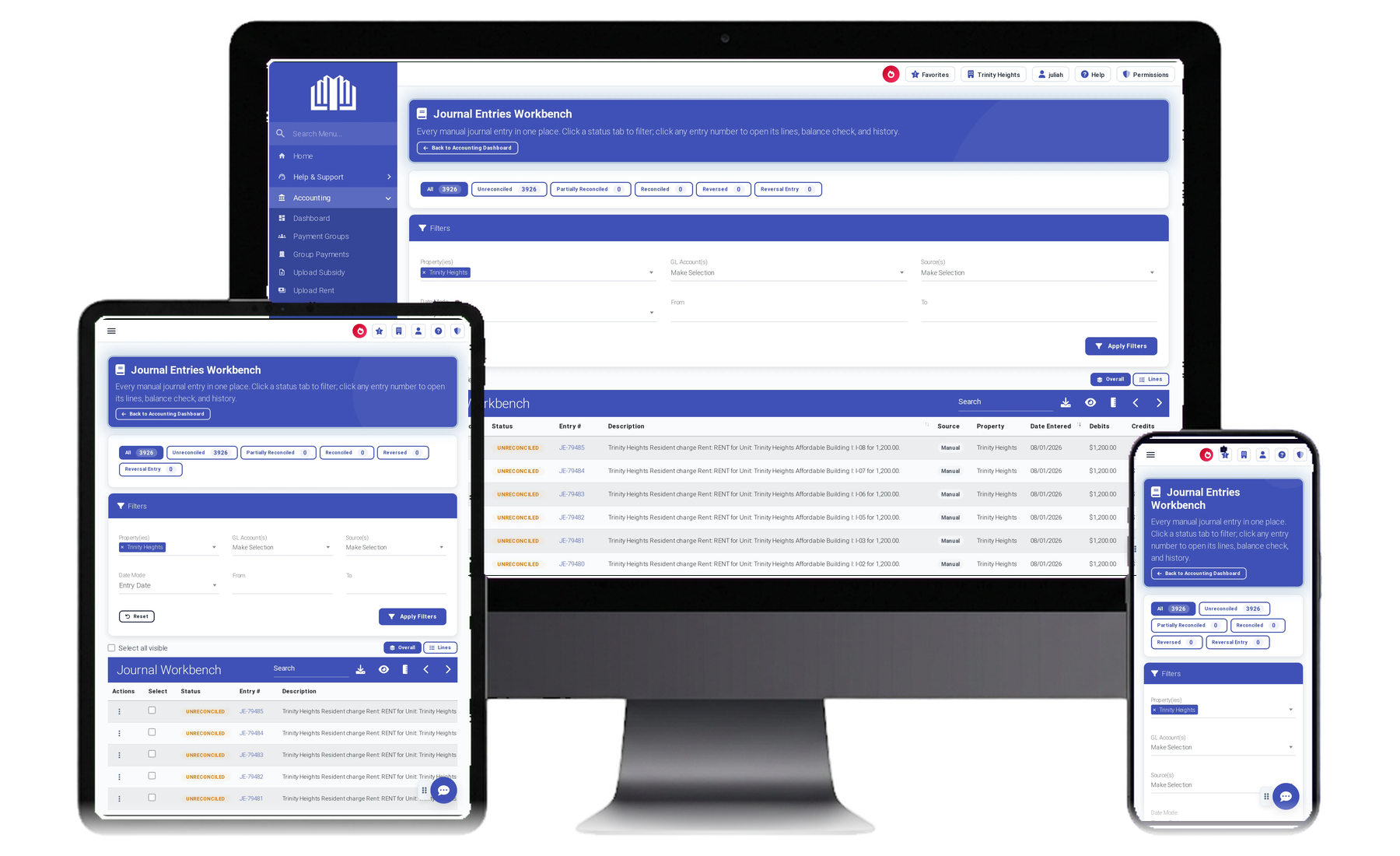
Applications, household/income/asset data, approvals and recertifications should create the evidence that later reporting needs — not require a separate reconstruction project.
Accounting does not stop being accounting because the property is affordable.
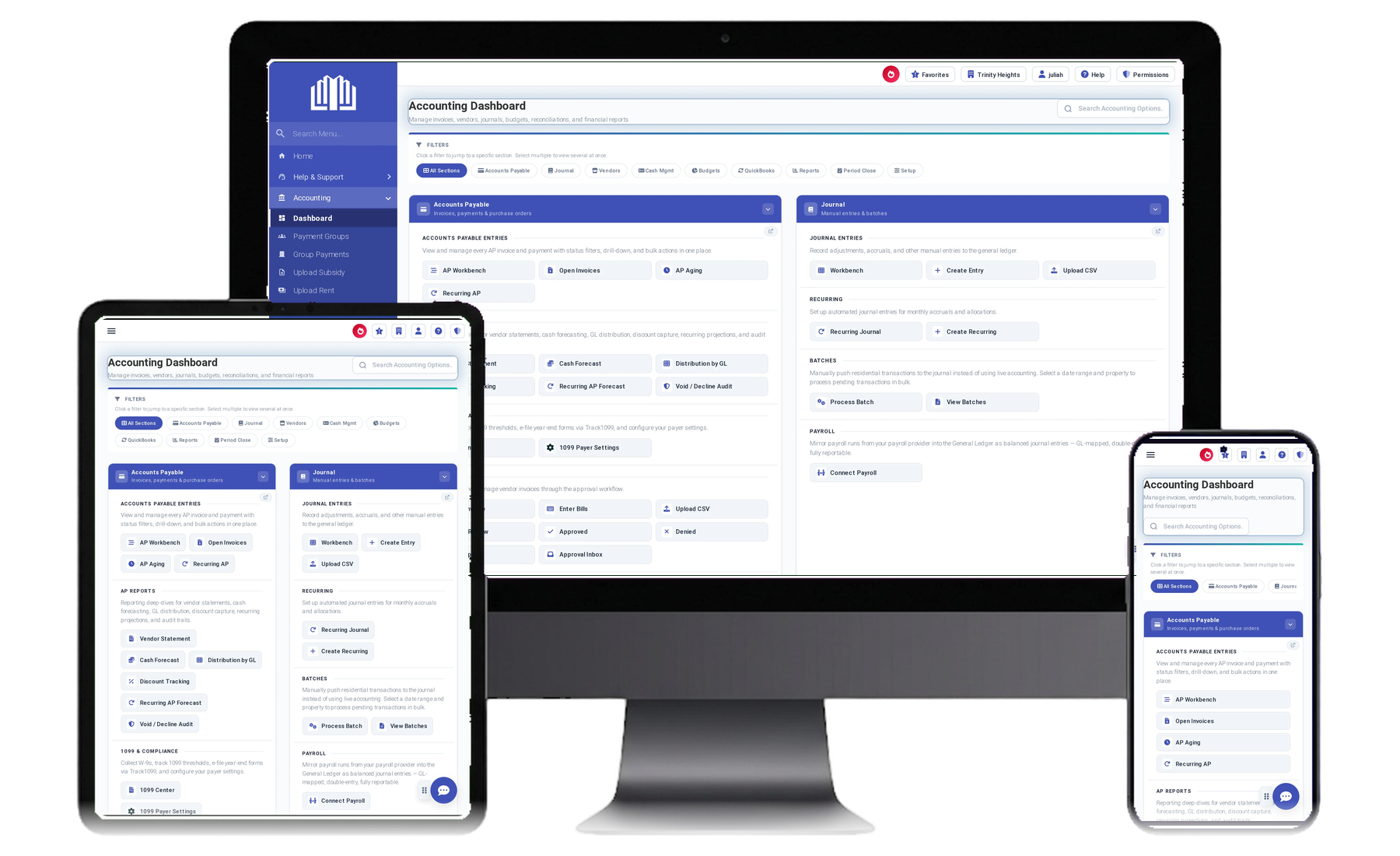
A subsidy payment and a resident payment are two lines against the same unit, and they belong in the same books as the rest of the portfolio — the same general ledger, the same reconciliation, the same statements.
The affordable properties do not close a different way from the conventional ones. The bookkeeping is one bookkeeping.
NSPIRE should create work, not spreadsheets.
NSPIRE dates and scoring differ by program, and the dates belong on the program pages that cite their HUD notice — not in a universal “NSPIRE ready” badge. The workflow is the same on each of them.
Deficiency
An inspection finding is recorded against the unit or building it was found in, not in a spreadsheet next to the report.
Work order
The finding becomes a work order with the deficiency attached, so the technician sees what the inspector saw.
Evidence
Assignment, completion and the photographs or notes that prove the repair are kept on the same order.
Verification
The finding closes when the repair is verified, and the history stays with the property for the next inspection.
EEva brings the context to the user.
Ask EEva the same question about a LIHTC property, a HUD Multifamily property, a public housing unit, a USDA Rural Development property and a Tribal property, and the answers differ — because the facts differ: a different certification form, different identifiers, a different authority, and for Tribal, a lane of its own.
On this page EEva works from a sample property for each program rather than from yours.
How much does affordable housing property management software cost?
Everything Included. Period.*
Custom pricing
Pricing is scoped to portfolio and workflow requirements. Ask for a written quote that identifies included capabilities, implementation scope, optional services, and payment-processing terms.
Payment processing
Review payment-processing terms, settlement timing, markup, and any resident fees in the written quote.
Written implementation scope
Document data migration, MAT and CSV import, staff training, validation, and go-live support in the written proposal.
Optional add-on
Business intelligence options can be scoped during evaluation. Ask which capabilities are included in the written quote.