ACCOUNTING & FINANCE
Stop reconciling property management to accounting. They should already agree.
ExactEstate's accounting system is the financial back end of the property workflow: charges, payments, vendor invoices, assets and bank activity can reach the books without recreating the same event in a separate system.
If accounting has to re-enter what property management already knows, the systems are not connected.
One transaction. The books already agree.
A resident is charged rent. On most systems that single event is then re-entered, re-coded and re-explained until four teams hold four versions of it.
In ExactEstate the charge lands on the operational ledger, maps to a balanced journal entry, posts to the general ledger accounts it belongs to, and shows up in the Trial Balance, the Income Statement and the Balance Sheet as the same transaction it started as.
Nobody re-keys it. Accounting reviews a number it can trace back to the unit and the household that produced it.
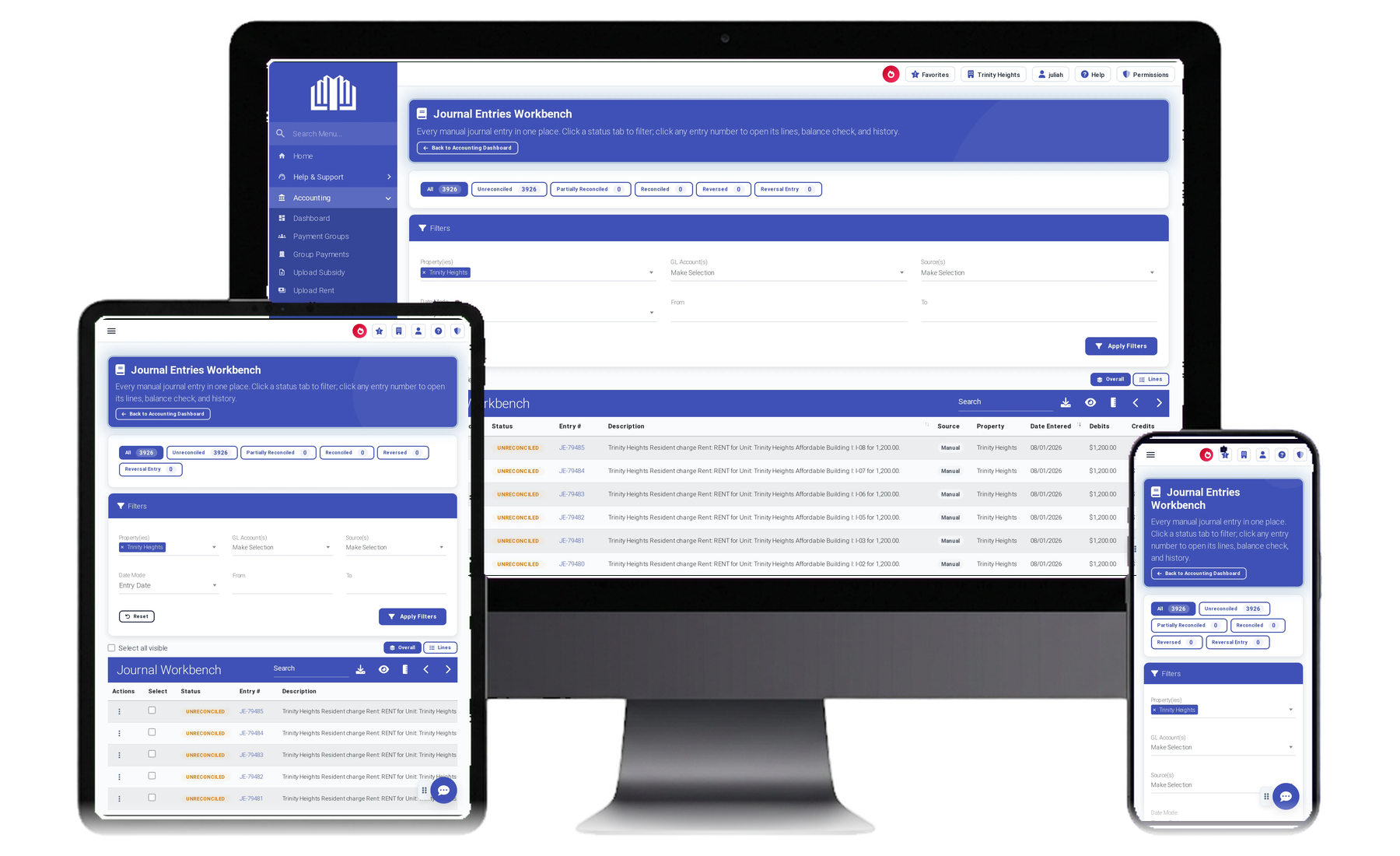
Site teams see the transaction. Accounting sees the books.
A site manager and a controller need to see different things. That is not a reason to give them different books.
Run cash and accrual books the portfolio requires.
Some portfolios report on a cash basis, some on accrual, and some owe both to different audiences in the same month.
ExactEstate carries book selection and reporting basis as a property of the report, not as a second copy of the data. The underlying property events stay connected either way, so switching the basis changes the statement rather than starting a new set of records.
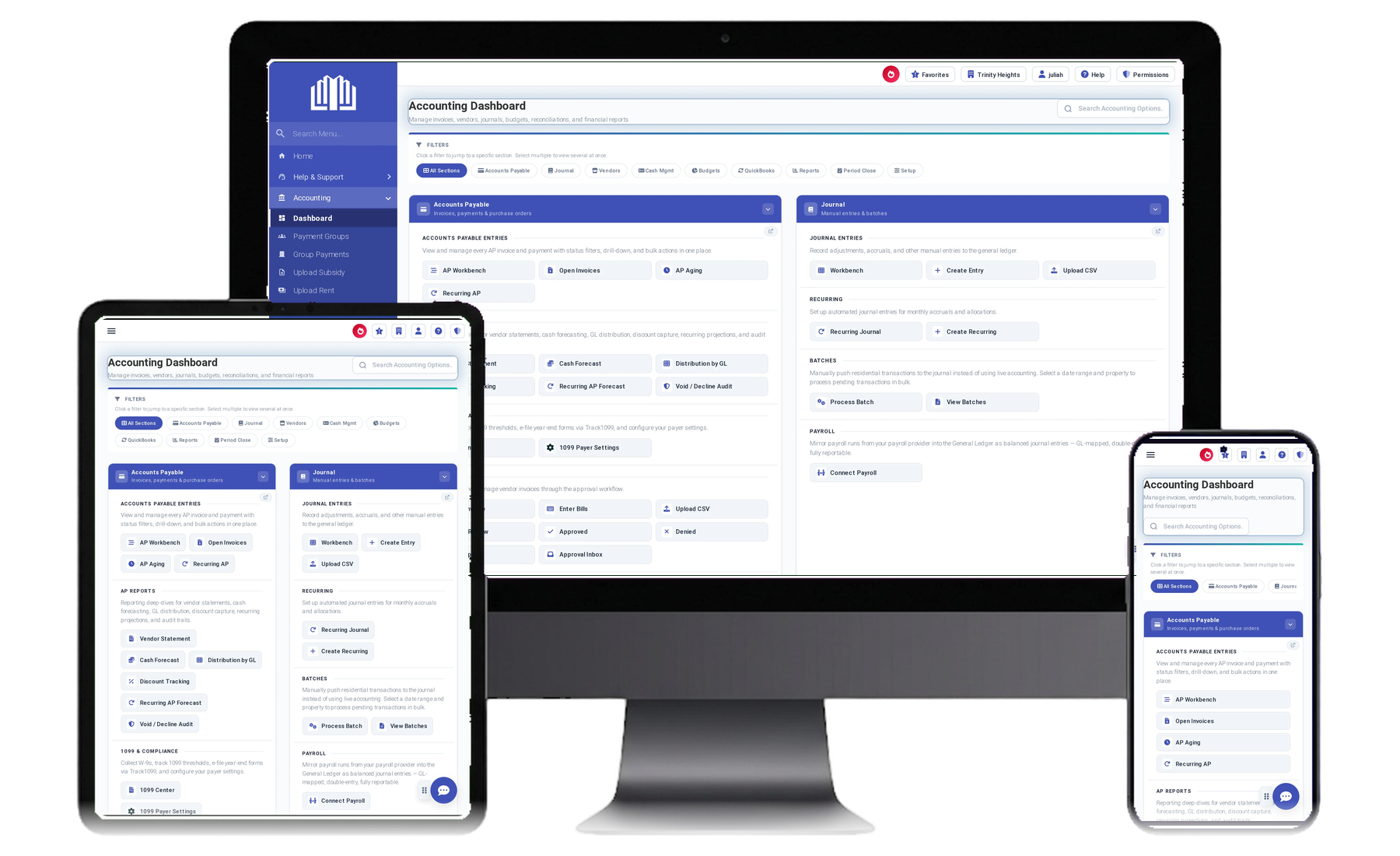
Drop in the invoice. Review the accounting, not the typing.
A vendor invoice arrives as a PDF and turns into twenty minutes of typing: vendor, property, amount, GL code, approval, payment, journal entry.
ExactEstate reads the document, extracts the fields, checks them against what the system already knows about the vendor and the property, and puts the coding in front of a person as a decision instead of a data-entry task.
Approval and payment follow the same invoice through to the journal entry. The reviewer reviews. The typing is the part that goes away.
Magic Map turns reconciliation into review instead of hunting.
Reconciliation is mostly hunting. A line on the bank statement is somewhere in the books, and the job is to find it.
ExactEstate matches external bank activity against book movements and shows how confident each match is, so the reconciliation session starts with the exceptions rather than with the whole month.
Splits, partial matches and the ones the system will not guess at stay in front of a person. What was matched, when, and by whom is kept as reconciliation history the next auditor can read.

Close and report without waiting for another spreadsheet.
Close should not depend on someone exporting to a spreadsheet and rebuilding the report by hand.
Trial Balance, Balance Sheet, Income Statement, T-12 and budget-versus-actual come off the same ledger the operations team has been posting to since the first of the month. Custom reporting sits beside them rather than replacing them.